Forex for beginners, what to master before your first trade
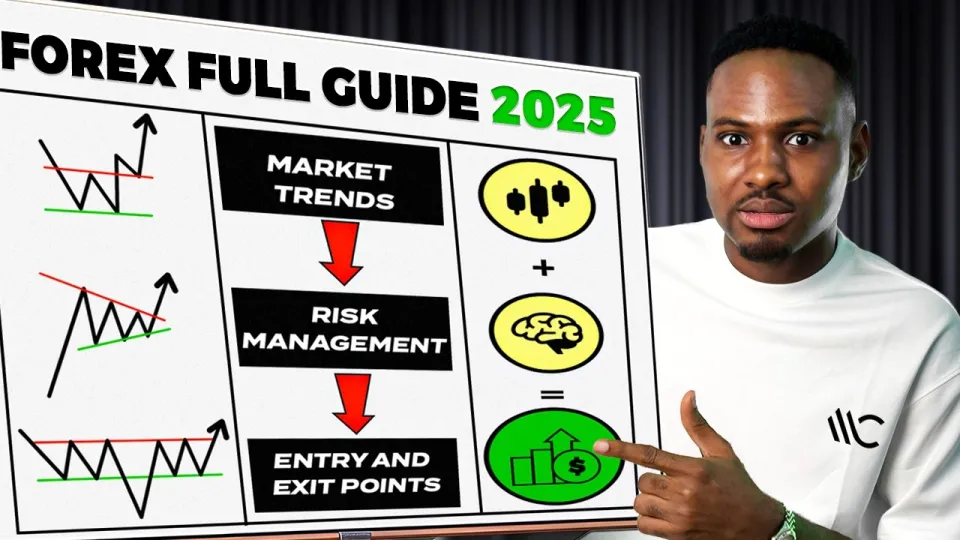
Video: How To Start Forex Trading For Beginners’ 2025 (Full Course)
Want articles like this for your own video to promote it on YouTube and Google? Order them through the Telegram bot @sat_sit_bot. The bot writes and publishes the articles itself (with your YouTube video embedded) on popular topical websites (no ads). Free trial — 50 articles.
· based on the channel Jeffrey Benson Forex
Key takeaways
- Forex is trading currency pairs such as EUR/USD, where the price reflects one currency against another and moves in pips.
- The market runs 24 hours a day, five days a week, split into Sydney, Tokyo, London and New York sessions.
- Minimum viable toolkit: a regulated broker, an MT5 terminal, a demo account and a trading journal.
- Risk per trade is capped at 1–2% of the account, and position size is calculated from stop distance, not from gut feeling.
- Jeffrey Benson Forex's full beginner course covers market mechanics, tools, strategy, the first trade and common mistakes.
Forex for beginners starts with three things: understanding that you are trading one currency against another, choosing a regulated broker with a platform like MT5, and risking no more than 1–2% of your account on a single trade. Everything else — strategy, indicators, session timing — is built on top of those three decisions. Jeffrey Benson Forex structures his full beginner course around exactly this order, and the course page with the paid plans is open at Fire Pips FX plans.
What forex trading actually is and why currencies move
Forex is the market where national currencies are exchanged in pairs, and every quote tells you how much of the second currency buys one unit of the first. In EUR/USD at 1.0850, one euro costs 1.0850 US dollars; the first currency is the base, the second is the quote. Prices are counted in pips — for most pairs the fourth decimal, so a move from 1.0850 to 1.0860 is ten pips.
Currencies move because capital flows between economies: interest-rate decisions from central banks, inflation prints, employment data, trade balances and risk sentiment all push money from one currency into another. A trader does not buy a company; they take a view that one economy will outperform another over a given horizon, and they express that view through a pair.
Leverage is what makes forex look fast. A broker may offer 1:100 or more, which means a small deposit controls a large notional position. That cuts both ways: it multiplies gains and losses on the same price move, so leverage is a sizing decision, not a profit strategy.
How the forex market works across sessions
The forex market is decentralised and runs continuously from Monday morning in Sydney to Friday evening in New York, which is why it is called a 24-hour market. There is no single exchange; banks, funds, brokers and retail traders are connected through an interbank network, and retail orders reach it through a broker.
Four sessions overlap and hand off liquidity:
- Sydney opens the week and is the quietest.
- Tokyo brings Asian ranges, with AUD and JPY pairs most active.
- London is the highest-volume session and sets the tone for the day.
- New York overlaps London for a few hours — usually the most volatile window, especially around US data releases.
Spreads widen when liquidity thins, typically at the rollover between New York close and Sydney open. A beginner who trades the dead hours pays more in spread and sees more random noise than a beginner who trades the London or London–New York overlap.
Tools you need before placing a trade
The minimum kit is small and mostly free: a regulated broker account, a trading terminal, a demo account and a journal. Everything else is optional until the basics are automatic.
- Broker. Regulation matters more than spreads. Check the licence, the entity that holds client funds, deposit and withdrawal methods, and whether the account type suits your size. The course recommends Assex Markets, with registration at https://my.assexmarkets.com/auth/register?partner_code=1699134 — treat any broker recommendation, including this one, as a starting point for your own due diligence.
- Platform. MetaTrader 5 (MT5) is the standard: charts, order types, indicators, and a strategy tester for backtesting. Linking a broker account to MT5 takes a few minutes and is covered in the author's setup walkthrough at https://youtu.be/oJ9Cz6dPZw0.
- Demo account. Trade the same size and the same rules on demo that you intend to use live. A demo used carelessly teaches nothing.
- Journal. Log entry, exit, reason, session and result for every trade. Patterns in your own data are worth more than any indicator.
- Economic calendar. Rate decisions and employment reports are scheduled in advance; knowing them prevents being surprised by a spike.
Building a basic strategy foundation
A beginner strategy is a set of rules that decides direction, entry, stop and target before the trade exists. Without those four numbers written down, a trade is a guess.
A workable starting framework:
- Direction from the higher timeframe. Mark the trend on the daily chart — higher highs and higher lows, or the reverse. Trade with it, not against it.
- A zone, not a signal. Identify a level where price previously reversed or broke out: a prior swing high or low, a round number, a session high.
- Entry trigger. Wait for price to reach the zone and show a reaction on a lower timeframe — a rejection candle or a break-and-retest. Entering because price is "moving fast" is not a trigger.
- Stop loss. Place it beyond the structure that would invalidate the idea, not at a round number of pips.
- Target. Use at least 1:2 risk-to-reward so a 40–50% win rate can still be profitable.
- Position size. Calculate it last: (account × risk %) ÷ stop distance = lot size. This is the single calculation that keeps an account alive.
Backtest the rules on at least 50–100 historical setups before risking money. The goal is not a high win rate; it is knowing what a normal losing streak looks like so it does not shake you out of a valid system.
Placing your first trade without breaking the account
The first live trade should be small enough that the result is emotionally irrelevant — the point is to execute the process correctly. Open MT5, select the pair, set the order type, enter the lot size calculated from your stop distance, and attach the stop loss and take profit before pressing the button.
Three habits to build from trade one:
- Write the reason for the trade in the journal before entry, not after the outcome.
- Never move a stop loss further away to avoid being stopped out; that is how a small loss becomes an account-ending one.
- Close the terminal after the trade is managed. Screen-watching after entry creates impulse decisions.
A common alternative route is copying signals — the author publishes one free setup daily through https://t.me/firepipsignals and a premium group via https://t.me/jeffreybenzhelpbot. Copying can teach execution mechanics, but it does not teach you to size a position or to sit through a drawdown, so it works best alongside your own journal rather than instead of it.
Common beginner mistakes and questions traders actually ask
Most beginner losses come from process errors, not from bad analysis. The recurring ones:
- Oversizing. Risking 10% per trade means five losses in a row remove roughly 40% of the account, and recovering from that requires a far larger gain than the loss.
- No stop loss. A position without a stop is not a trade plan; it is a hope.
- Revenge trading. Doubling size after a loss to "get it back" is the fastest documented route to a blown account.
- Strategy hopping. Switching systems after three losses guarantees never collecting enough data to judge any of them.
- Ignoring the calendar. Getting stopped out by a rate decision you did not know about is avoidable.
The questions beginners raise most often are about time: how long until profitable, how much capital is needed, and whether a demo account is a waste of time. The honest answers are that profitability is a function of repetition and record-keeping rather than months, that a small account is fine if risk per trade is scaled down, and that demo is valuable only when it is traded with the same rules and size as live money.
Useful links
- Course plans and student access: https://firepipsfx.com/plans
- Free daily signal channel: https://t.me/firepipsignals
- Broker registration used in the course: https://my.assexmarkets.com/auth/register?partner_code=1699134
- Premium signal group access: https://t.me/jeffreybenzhelpbot
- MT5 and broker setup walkthrough: https://youtu.be/oJ9Cz6dPZw0
Bottom line
Forex rewards a boring process: one pair, one set of rules, a fixed risk percentage and a journal that tells the truth about your results. Beginners who survive the first year are rarely the ones with the cleverest indicator — they are the ones who kept position size small and kept records. The full beginner course from the Jeffrey Benson Forex channel is a solid structured starting point, and its paid plans are available through Fire Pips FX. Start on demo, prove the rules over a few dozen trades, then go live with money you can afford to lose.
Questions & answers
How much money do I need to start forex trading?
There is no fixed minimum, but the account size must fit your risk rule. If you risk 1% per trade and your stop is 20 pips, a $500 account means very small positions — which is fine for learning execution. Many brokers accept $50–$100 deposits, though very small accounts leave little room for error and are best treated as practice.
How long does it take to become profitable in forex?
It depends on how many documented trades you complete, not on calendar time. A trader who journals 100 backtested and 50 demo trades with fixed rules learns faster than one who trades randomly for two years. Expect months of deliberate practice before judging whether a system has an edge.
Is a demo account useful or a waste of time?
Demo is useful when it is traded exactly like live money: same lot-size formula, same rules, same journal. It becomes a waste of time when traders take oversized risks because nothing is at stake. Use demo to prove the process, then move to a small live account to learn the emotional side.
Can I just copy signals instead of learning to trade?
Copying signals can teach execution and show how a professional structures entries, but it does not build position-sizing skill or the ability to sit through a losing streak. The practical approach is to copy a small number of setups while running your own journal so you understand why each trade was taken.
Source: How To Start Forex Trading For Beginners’ 2025 (Full Course) · Markdown version